TWK Scaffolding · Contractor assurance

Safety & Standards at TWK Scaffolding

Proper planning. Competent people. Independent oversight.

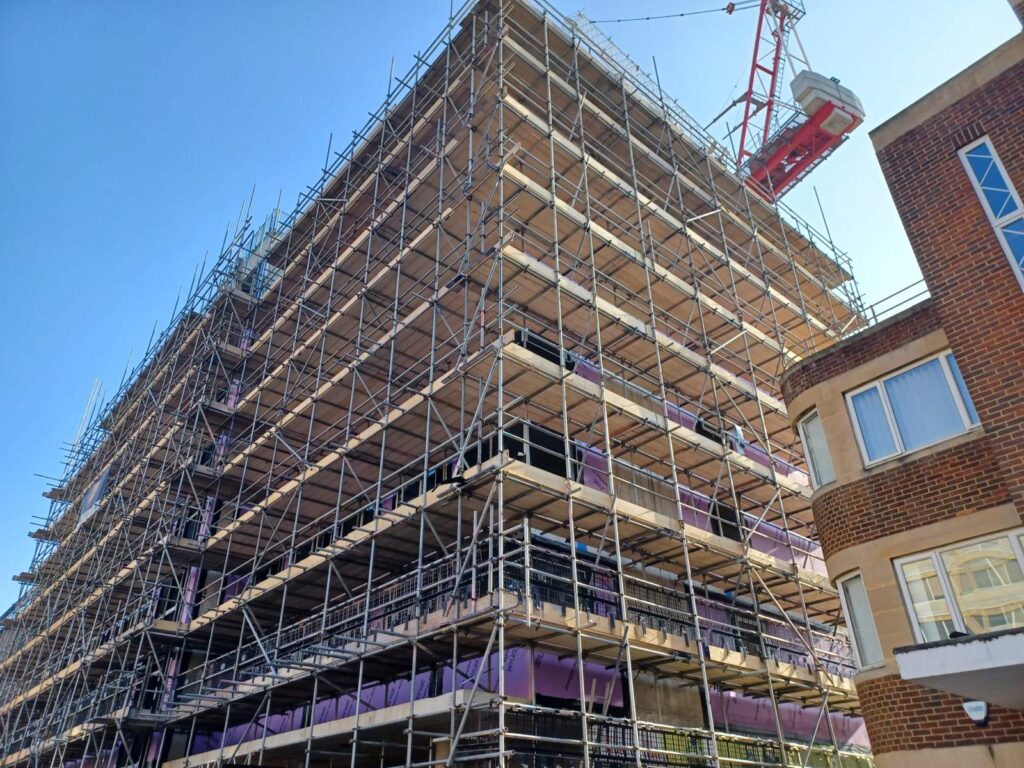
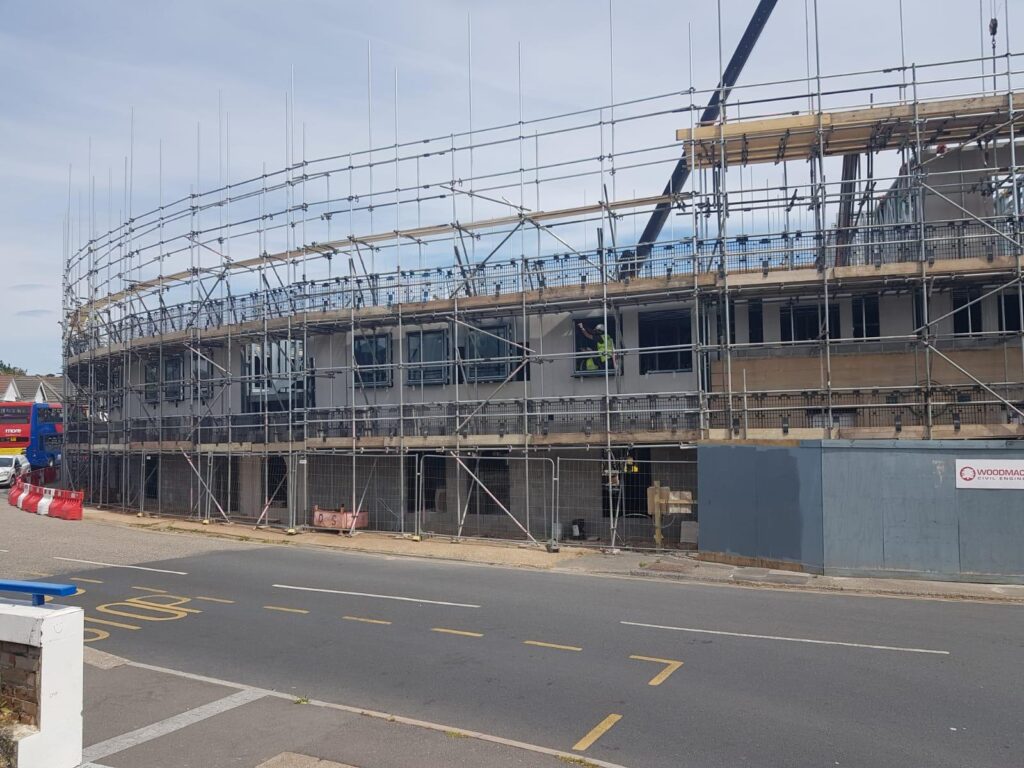
Access scaffolding at Hendy House in Bournemouth

Planning and Control on Every Scaffold

A scaffold needs to be safe to erect, safe to use and safe to dismantle. Achieving that starts well before our operatives arrive on site.

At TWK Scaffolding, we approach safety through practical planning, competent supervision and clear communication between our management team, scaffolders and the contractors using our structures.

Every project starts with an assessment of the building, ground conditions, working environment and access requirements. We establish the appropriate scaffold design, prepare site-specific risk assessments and method statements, and make sure the team understands the agreed arrangements before work begins.

As an NASC Contractor Member, we work to recognised industry guidance and maintain the competence, management systems and operational standards expected of our membership.

We also retain SIMIAN Risk Management as our independent health and safety adviser, providing specialist guidance, reviews and monitoring beyond our own internal procedures.

Our approach is supported by four important elements:

  • NASC Contractor Membership and recognised industry accreditations
  • Project-specific risk assessments, method statements and scaffold design information
  • Competent scaffolders, experienced supervision and appropriate training
  • Scaffold handover, statutory inspection arrangements and independent safety monitoring

Memberships & Accreditations

TWK maintains recognised industry memberships and supply-chain accreditations to support clients’ procurement and contractor assessment requirements.

NASC Contractor Member

NASC — Contractor Member

The National Access & Scaffolding Confederation is the UK’s principal trade body for scaffolding and access.

Contractor membership involves independent auditing against recognised membership criteria, including health and safety management, training, competence and operational procedures.

Our NASC membership provides additional assurance to clients selecting a scaffolding contractor for commercial, industrial and specialist projects.

Constructionline Gold

Constructionline Gold

Constructionline Gold supports contractor pre-qualification across a wider range of procurement requirements, helping principal contractors and procurement teams assess supplier credentials.

CHAS

CHAS

CHAS provides recognised health and safety pre-qualification, including assessment against the relevant Safety Schemes in Procurement (SSIP) criteria.

SMAS Worksafe

SMAS Worksafe

SMAS Worksafe is an SSIP-recognised assessment scheme, providing independent assessment of contractor health and safety management arrangements.

SafeContractor

SafeContractor

SafeContractor provides contractor accreditation and assessment against applicable health and safety requirements, supporting commercial and supply-chain procurement.

These assessments support procurement, but they do not replace the site-specific planning needed for individual scaffolding projects.

Current accreditation certificates, insurance and supporting documentation are available to clients upon request.

How We Manage Safety — Plan, Do, Check, Act

Our approach follows a straightforward management cycle. We plan the work, carry it out using agreed procedures, check that those arrangements are being followed and act on anything that needs improving.

01

Plan — Understand the Risks Before Starting

Before erection, we establish the scaffold requirements and the conditions in which our team will be working.

This includes site surveys, ground and structural conditions, access restrictions, scaffold loading, design requirements and the proposed erection sequence.

Project-specific RAMS are prepared, with rescue arrangements and additional controls incorporated where the nature of the work requires them.

02

Do — Competent Teams Working to the Agreed Method

Scaffolding is erected, altered and dismantled by operatives with competence and supervision appropriate to the task.

Teams are briefed on the method statement, design information and site restrictions before starting.

We follow NASC SG4 guidance for preventing falls during scaffolding operations, using collective protection wherever practicable and suitable personal fall protection where required.

Supervisors, inductions and toolbox talks help ensure the agreed controls are understood and followed.

03

Check — Inspections, Monitoring & Review

Completed scaffolds are subject to the required inspections, with the permitted loading and any restrictions communicated at handover.

We also review site practices through management checks and independent health and safety monitoring undertaken by SIMIAN.

Where shortcomings or changing conditions are identified, they are addressed rather than allowed to become accepted working practices.

04

Act — Learn and Improve

Findings from inspections, audits, incidents and near misses are reviewed by management.

Where necessary, we update working methods, briefings, training or site controls, with corrective actions tracked through to completion.

The aim is to keep improving how work is planned and carried out, rather than relying on procedures that are never reviewed.

Before Our Team Starts Work

A properly briefed scaffolding team should know what is being built, how it is being erected and what restrictions apply.

Our pre-start arrangements follow a clear sequence:

  1. Site survey: Establish the structure, working area, ground conditions, access and potential hazards.
  2. Risk assessment: Identify the risks associated with the scaffold and surrounding activities.
  3. Method statement: Establish the erection, alteration and dismantling arrangements.
  4. Design review: Confirm the applicable TG20, TG30, manufacturer’s configuration or bespoke design.
  5. Operative briefing: Communicate the design, safe working method and site-specific restrictions.
  6. Erection and supervision: Carry out the works in accordance with the approved arrangements.

If the conditions encountered on site differ from the information provided during planning, we review the method before proceeding.

Competence, Training & Working at Height

Different scaffolding arrangements require different levels of competence.

Our workforce includes operatives working within the CISRS training and qualification structure, including Trainee Scaffolders, Scaffolders and Advanced Scaffolders.

We maintain training and competence records so that operatives are allocated work appropriate to their qualifications, experience and supervision requirements.

Relevant training and controls include:

  • CISRS scaffolding qualifications and progression
  • SSPTS and manufacturer-specific system training where required
  • Scaffold inspection competence
  • Site inductions and toolbox talks
  • Manual handling and safe material movement
  • NASC SG4 fall-prevention methods
  • Harness inspection and working-at-height procedures

Scaffold Design, Handover & Inspection

The Right Design for the Job

Not every scaffold requires a bespoke engineered design, but every scaffold needs an appropriate structural basis.

We use NASC TG20 for traditional tube-and-fitting scaffolding and TG30 or applicable manufacturer guidance for system scaffolding where the configuration falls within the relevant parameters.

Where standard arrangements are unsuitable, we coordinate a project-specific design, supported by structural calculations and appropriate design checks.

The design considers loading, stability, ground conditions, ties, bracing, wind exposure and any additional requirements introduced by temporary roofs, sheeting, loading bays or specialist arrangements.

Our teams work to the applicable drawings and compliance information, with no unauthorised changes to the approved arrangement.

Anchor Testing & Structural Checks

Scaffold ties are a critical part of the stability of many access structures.

Fixing positions, supporting materials and the required tie resistance are considered during planning, with preliminary and proof testing carried out and recorded as appropriate to the design and anchorage requirements.

Where testing identifies unsuitable masonry or other structural limitations, alternative arrangements must be established before relying on those fixings.

Handover & Ongoing Inspections

Scaffolds are inspected by a competent person before first use, at intervals not exceeding seven days for construction scaffolds, and following substantial alterations or events that could affect their safety.

Handover information identifies the scaffold’s intended use, permitted loading and any restrictions.

Inspection responsibilities are agreed with the scaffold user or hirer, with TWK providing statutory inspection services where included within our appointment.

For designed scaffolds, inspections must take account of the actual design and any specific requirements associated with the structure.

Independent Health & Safety Advice — SIMIAN Risk Management

TWK retains SIMIAN Risk Management to provide independent, competent health and safety advice and monitoring.

SIMIAN specialises in construction and scaffolding safety, providing technical guidance and independent assessment of working practices.

Their involvement supports our management team with:

  • Advice on legislation and industry standards
  • Review of health and safety policies and procedures
  • Guidance on day-to-day site safety matters
  • Independent monitoring of scaffolding operations
  • Training and competence-related advice
  • Recommendations arising from inspections and management reviews

Monitoring findings are reviewed by TWK management, with corrective actions allocated and followed through.

This provides an additional level of scrutiny beyond routine scaffold inspections and internal site supervision.

Independent advice is particularly valuable when dealing with unusual projects, changing regulations or working methods that require further technical consideration.

Protecting the Wider Working Environment

Scaffolding safety extends beyond the people erecting or using the structure.

Our planning also considers other contractors, building occupants, pedestrians and anyone who may be affected by the works.

Occupational Health & Workforce Welfare

Relevant occupational health risks include manual handling, noise, vibration, respirable dust and exposure to hazardous substances.

We consider suitable controls, COSHH requirements and health surveillance where applicable.

Welfare, fatigue management, first-aid arrangements and mental health awareness also form part of our wider responsibility towards the workforce.

Public Protection & Occupied Buildings

Many of our projects take place in operational schools, hospitals, commercial buildings and occupied residential properties.

These environments require careful planning of pedestrian segregation, deliveries, exclusion zones, protected entrances and the timing of scaffolding activities.

Our operatives are enhanced DBS-checked, supporting work in schools and other sensitive environments.

On MOD and restricted sites, we also coordinate the required personnel vetting, VIVO-related credentials where applicable, inductions and establishment-specific permissions.

Incidents & Near Misses

We encourage the reporting of incidents, unsafe conditions and near misses.

These are reviewed to identify their causes and determine whether changes are required to working methods, supervision, equipment or training.

Findings are communicated to relevant teams so lessons are applied to future work.

Safety in Practice — TWK Projects

The most useful measure of a safety procedure is how it works when site conditions become difficult.

Our projects provide practical examples of how planning, testing and adapting working methods can make a difference.

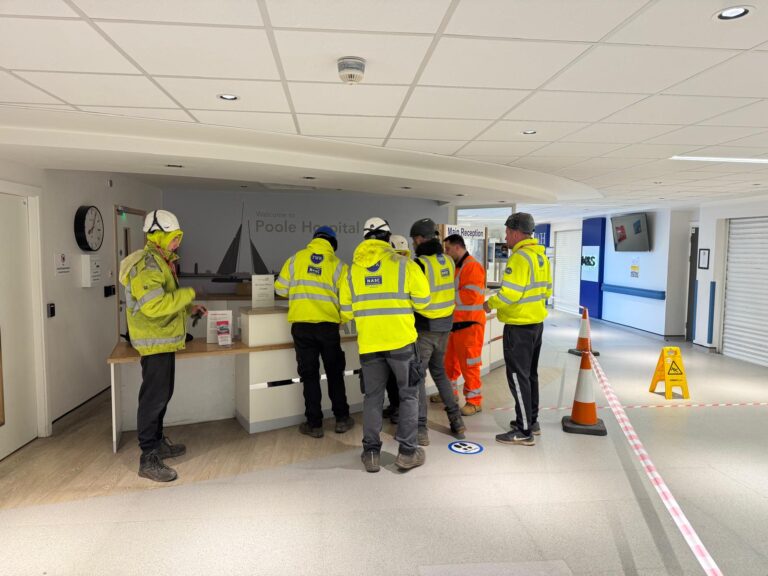
TWK scaffold team and materials in a reception area at Poole Hospital

Poole Hospital — A Two-Day Installation Within a Live Hospital

TWK erected a fully designed crash deck and birdcage over stairwells and a glass-roofed office annexe within Poole Hospital.

With just one weekend available, eight operatives worked two 10-hour shifts, completing the protective structure before the hospital’s busier Monday morning operations.

The project demonstrates the importance of preparation, competent supervision and managing works within an operational healthcare environment.

View project →

Aerial view of temporary-roof structures and scaffold access at Canford Heath schools in Poole

Canford Heath Schools — Structural Testing & Safeguarding

During the installation of two large temporary roofs at Canford Heath Infant and Junior Schools, tie pull tests identified masonry that couldn’t provide the required resistance.

Rather than proceed with unsuitable fixings, we developed alternative supporting arrangements and adapted the installation.

The works were also carefully phased around the school calendar, with ground-level activities completed before pupils returned in September and controlled exclusion zones maintained during the remainder of the programme.

View project →

Potters Grove, Poole — Working Near Overhead Power Lines

At Potters Grove, parts of the residential development were affected by live overhead electrical lines.

We carried out site-specific assessments for the affected plots and adapted scaffold erection and tube-handling arrangements to accommodate the restrictions.

The project demonstrates why electrical hazards need to be considered during planning rather than relying on a standard erection method across every plot.

View project →

Access scaffolding and sheeted internal work areas at Harwin’s manufacturing project in Portsmouth

Harwin Manufacturing Facility — Exposed Weather Conditions

At Harwin’s Portsmouth manufacturing facility, the exposed location experienced winds reaching approximately 45mph at times.

TWK developed an alternative method for installing bespoke scaffold frames and shrink-wrap encapsulation, with the installation programme adapted to suit site conditions and safe operating limits.

The protection helped allow other trades to continue their internal works within a more sheltered environment.

View project →

Perimeter access scaffolding at The Cosmopolitan apartment development in Poole

The Cosmopolitan, Poole — Working Beside Live Traffic

TWK provided perimeter access scaffolding for more than 40 weeks on a residential development beside one of Poole’s busiest roundabouts.

Scaffold erection, alterations and deliveries had to be coordinated around the surrounding traffic and pedestrian environment throughout the construction programme.

The project demonstrates the importance of maintaining suitable controls during a long-term installation, not simply at the initial erection.

View project →

What Our Clients & Safety Advisers Say

SIMIAN Risk Management

“TWK Scaffolding has consistently demonstrated a collaborative approach to health and safety.”

Jamie Lyons — Consultancy Manager / Senior H&S Adviser, SIMIAN Risk Management

Westmade Ltd

“Throughout our working relationship, TWK Scaffolding has consistently demonstrated an exemplary level of professionalism and expertise.”

Blake Lennan MCIOB — Contracts Manager, Westmade

Knights Brown

“Throughout the duration of the works, Tomas Karbowiak and the TWK Scaffolding team demonstrated a high level of professionalism and reliability.”

Eugenio Rodrigues — Senior Site Manager, Knights Brown

Safety Documentation for Tenders & Supply-Chain Reviews

We understand that principal contractors, procurement teams and facilities managers need reliable, current documentation when assessing scaffolding contractors.

TWK can provide relevant information for tender submissions and pre-qualification checks, including current accreditation certificates, insurance, health and safety policies and supporting competence documentation.

Project-specific RAMS, scaffold designs and other technical information are prepared and provided as appropriate to individual appointments.

Safe Access Starts with Proper Planning

Whether you’re planning conventional access scaffolding, a temporary roof or a fully engineered specialist structure, TWK Scaffolding can help establish an appropriate arrangement from the outset.

Contact TWK to discuss your project, access requirements and safety planning.