
Specialist scaffolding service
Suspended & Hanging Scaffolding in Dorset & Hampshire
Not every scaffold can be built from the ground up. Bridges, overhanging structures, deep voids and buildings positioned above water or busy access routes can make conventional scaffolding impractical or, in some cases, impossible.

Service Overview
Suspended and hanging scaffolds provide an alternative by supporting the working platform from a suitable structure above, rather than relying on standards extending down to ground level.
Using specialist beams, cantilever arrangements and suspended scaffold components, we can create working platforms beneath bridges, around projecting structures and in areas that would otherwise be extremely difficult to reach.
TWK Scaffolding designs and erects fully engineered suspended and hanging scaffolds across Dorset, Hampshire and the surrounding areas, supporting bridge maintenance, structural repairs, industrial works and specialist refurbishment projects.
These are rarely straightforward installations. The supporting structure, method of suspension, erection sequence and access arrangements all need careful consideration before work begins.
Applications & Available Solutions
Every hanging scaffold presents a different engineering challenge. The most suitable arrangement depends on the available supporting structure, the working area required and the loads the platform needs to accommodate.
Hanging & Underslung Scaffolds
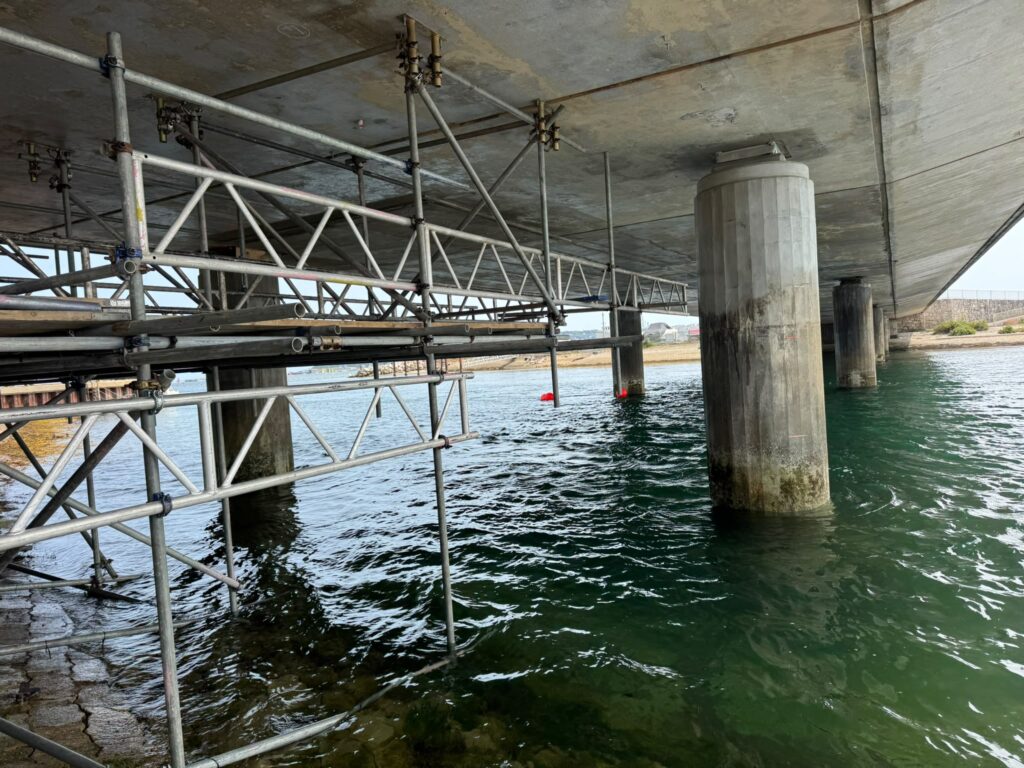
Hanging scaffolds provide working platforms suspended beneath an existing structure, typically using engineered suspension points, scaffold tubes, beams or suitable proprietary components.
They are particularly useful beneath bridges, steel-framed structures and large soffits where conventional ground-supported scaffolding would be impractical.
The working platform can be configured to provide access for concrete repairs, steelwork maintenance, painting, inspections and other specialist activities.
Cantilevered & Truss-Out Scaffolding
Where access is required beyond the edge of a building or structure, a cantilevered arrangement can provide support for a working platform without requiring standards directly beneath it.
Using appropriately designed beams, brackets and supporting scaffold components, loads can be transferred back into the existing structure.
These arrangements are particularly useful around projecting balconies, building overhangs, bridge edges and locations where the ground below must remain unobstructed.
Needle Beam & Counterweighted Arrangements
Where suitable structural openings or supporting points are available, needle beams can be used to project beyond the building and support suspended working platforms.
In some situations, counterweighted arrangements may provide an alternative where conventional structural fixings are unsuitable.
Both methods require project-specific engineering to establish the supporting loads, structural capacity, restraint and stability requirements.
The available building structure ultimately determines which solution is practical.
Working Platforms & Containment
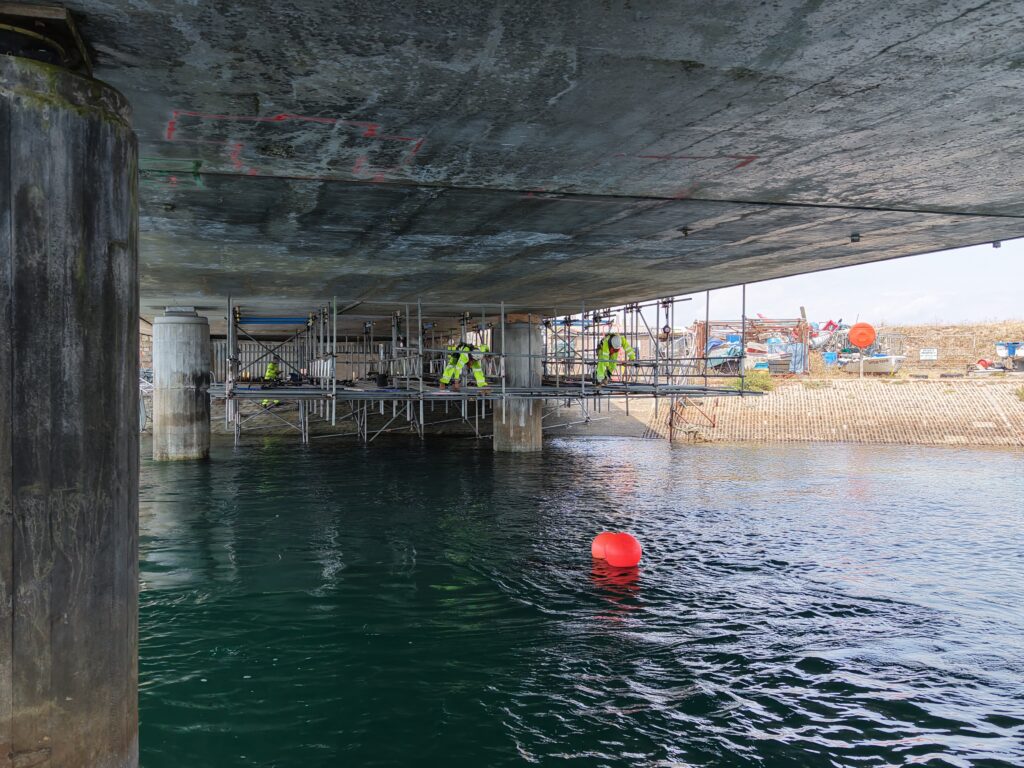
Suspended scaffolds can incorporate boarded working platforms, guardrails, toe boards and suitable access arrangements to meet the needs of the trades using them.
Where work takes place above water, public areas or operational environments, additional measures such as debris netting, protective sheeting or containment may be required.
These are considered as part of the scaffold design, including any additional loading they introduce.
Typical Applications
- Bridge and viaduct maintenance or repairs
- Marine structures and works above water
- Structural steelwork and concrete soffits
- Balconies, canopies and projecting structures
- Industrial installations and maintenance
- Work above roads, voids and restricted-access areas
The TWK Approach
Suspended scaffolding requires a different approach to conventional access scaffolds. With the working platform supported from above, understanding how the loads are transferred into the existing structure is essential.
We start with a detailed site survey, looking at the structure, available fixing positions, required working area and the restrictions surrounding the proposed works.
One of the first considerations is whether the existing structure can safely accommodate the additional loading. Where necessary, we work alongside structural engineers to verify the supporting elements and develop an appropriate fixing or suspension arrangement.
Every installation is supported by a project-specific scaffold design, with structural calculations covering the supporting beams, connections, suspension points, platform loading and overall stability.
Just as importantly, we consider how the scaffold will actually be erected.
Working beneath bridges, over water or above inaccessible areas can make conventional erection methods unsuitable. The design therefore needs to account for temporary support, lifting arrangements, safe access and the stability of the structure throughout each stage of installation.
Where works take place above operational areas, we coordinate with the client to establish suitable protection, exclusion zones and any necessary restrictions on activities below.
Our experienced teams erect the scaffold in accordance with the approved drawings and site-specific method statements, with suitable supervision, inspection and controlled procedures for alteration and dismantling.
The aim is to provide a safe, practical working platform in locations where conventional scaffolding simply isn’t an option.

Discuss Your Suspended Scaffolding Requirements
Whether you require a hanging scaffold beneath a bridge, a cantilevered working platform or specialist access where conventional scaffolding cannot be supported from the ground, TWK Scaffolding can help develop a suitable engineered solution.
Contact our team to discuss your project and arrange a site survey and quotation.